
Our molded nonwoven products – your benefits
✔ Excellent sound absorption – effective noise reduction and vibration damping
✔ Excellent thermal insulation – improves the energy efficiency of your systems
✔ Tailored shapes – Perfectly adapted to demanding component geometries
✔ Lightweight & sustainable – resource-saving materials with low weight
✔ High robustness – Resistant to moisture, oil, etc.
✔ Flexible production – manufacturing process for small batch and series production
✔ Support in the creation of the design, including feasibility analysis
✔ Wide variety of materials – for noise control in combination with tech solutions
✔ On-site consultation – for an ideal fit to your vehicle
✔ Ready-to-install – for quick and easy integration
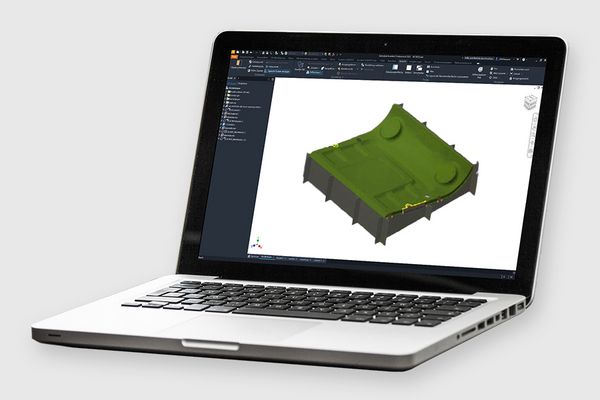
Ready-to-install soundproofing and insulation solutions for vehicles and machines
Molded non-woven products are the perfect choice for effective sound and heat insulation in technical applications. Cellofoam develops and produces high-quality molded non-woven products that can be adapted optimally to complex geometries and are used in vehicles, machines and industrial applications.
Customized interior parts for the highest requirements
In our non-woven molding processes, state-of-the-art machines and presses turn the non-wovens into dimensionally stable, self-supporting, two- and three-dimensional parts according to customer specifications. The resulting products score with their excellent acoustic effectiveness and high dimensional stability.
Innovative production & sustainable combination materials
We match and combine various materials to create targeted solutions for different surface requirements and applications. Our non-woven products are based on high-quality polyester fibers (PES) and are partly made from recycled materials. Innovative production techniques such as thermomolding, water jet cutting and punching, enable us to realize tailor-made solutions for a wide range of sectors.
Get in touch now & discover tailored solutions!
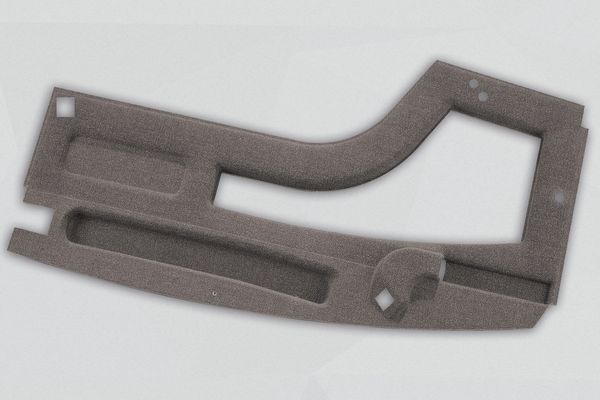
Molded non-woven parts from Cellofoam are used as
✔ Cabin lining – reduces noise and improves the indoor climate
✔ Head liners – light and robust lining with optimum sound absorption effectiveness
✔ Side panel liners – functional and aesthetic solutions for interiors
✔ Rear wall cladding – optimizes the interior acoustics and reduces droning
✔ Beam cladding - acoustically optimized for load-bearing body structures
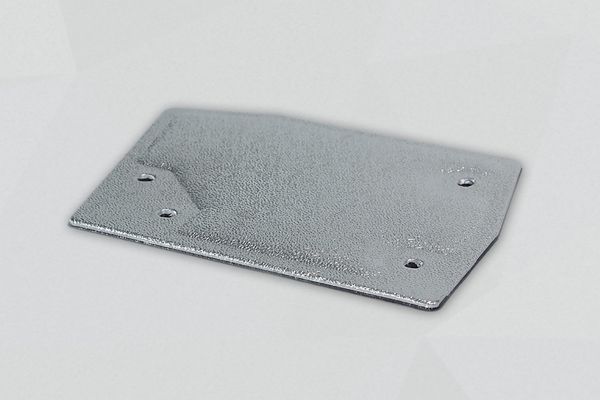
✔ Technical covers – dimensionally stable elements for machines & vehicles
✔ Engine compartment liners – heat-resistant and sound-absorbing
✔ Hood covers – combine thermal insulation with sound absorption
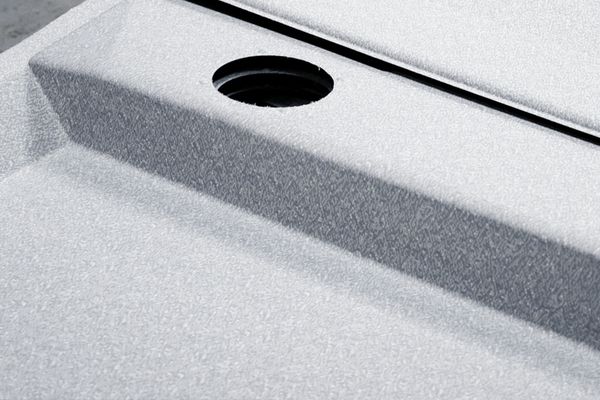
Processing technologies
- Fully automated thermomolding production line
- Hot pressing and cold pressing for thermoplastic materials
- 70- to 400-ton presses
- Two- and three-dimensional parts up to a size of 1900 x 2100 x 400 mm
Depending on the material, the batch size and the geometry of the parts, we use different, optimally matched production methods and tools. In this way, we ensure that every solution convinces on both the technical and the economic level.
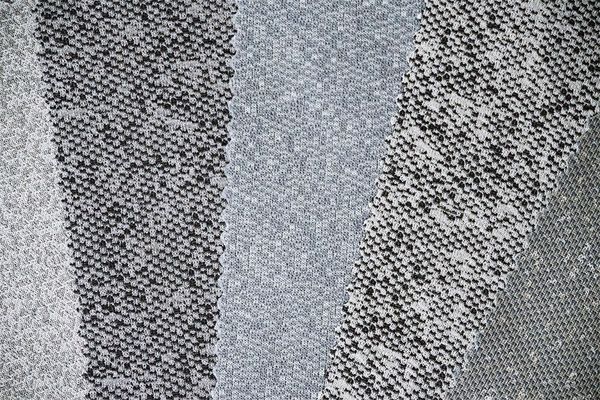
Materials
- Various non-wovens made from viscose or polyester fibers
- Mixed-fiber non-wovens
- Wide range of visually attractive facing materials, for instance:
- Decorative non-woven with excellent technical properties (washable, oil- and water-repellent, resistant to high-pressure cleaning)
- Mechanically robust needled felts
- Various knitted fabrics with high elasticity for perfect adaptation to surface contours
- Heat-reflecting aluminum films and foils
Optional: Customer-specific facing materials on request.
Typical uses
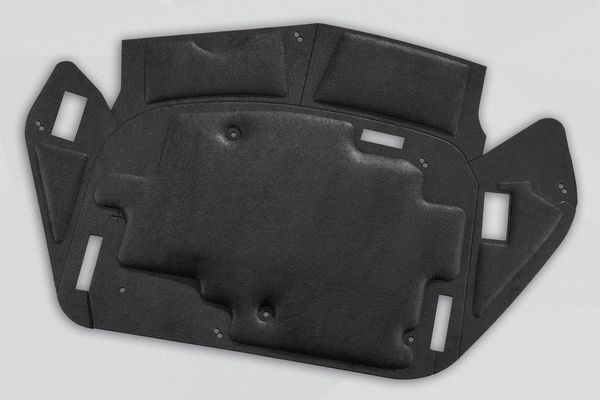
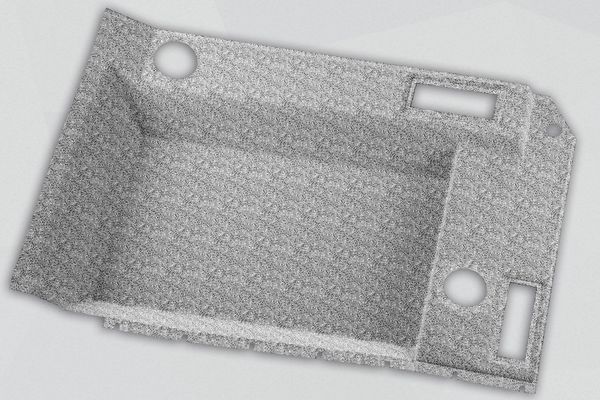
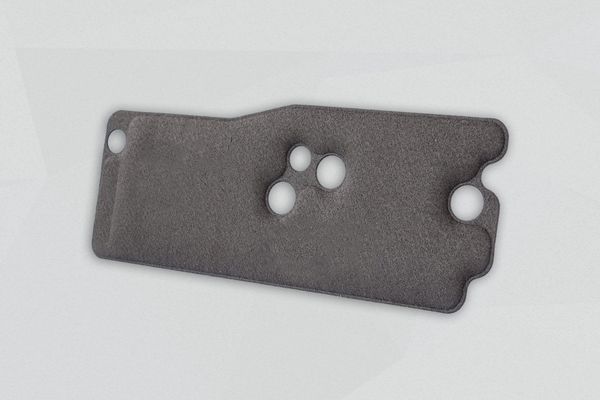
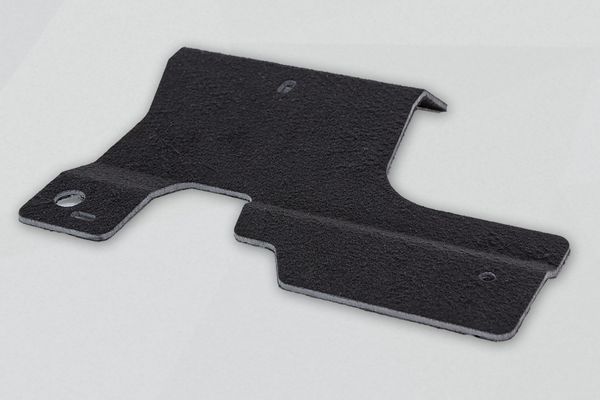
FAQ
Here you will find answers to frequently asked questions about our non-woven moulding process
Non-woven moulding is a thermal or mechanical process in which textile non-wovens are shaped into three-dimensional forms. This results in lightweight, stable and customisable components.
Moulded non-wovens are lighter, acoustically effective, cost-efficient, recyclable and offer flexible design options – ideal for technical applications.
Typical applications include headliners, cabin and side panelling in construction and agricultural machinery, as well as interior trim components for engine compartments in buses and commercial vehicles.
In addition, moulded non-woven parts are also used as technical panelling for machinery.
Thanks to thermoforming and pressing processes, complex 2D and 3D geometries, contours, curvatures and functional elements such as recesses or mountings are possible.
The non-woven fabric is heated, moulded, held in place in the mould and then cooled. Depending on the process, additional finishing treatments, coatings or laminations may be applied.
Yes, shaped non-woven fabrics offer excellent sound-absorbing and sound-insulating properties – ideal for noise reduction and vibration damping in machinery and vehicles.
Yes, Cellofoam develops bespoke 2D and 3D non-woven moulded parts, tailored to the geometry, material properties, acoustic objectives and temperature requirements.
Many non-woven fabrics are recyclable, made from recycled fibres or composed of resource-efficient, lightweight materials – an advantage over solid plastic components.